
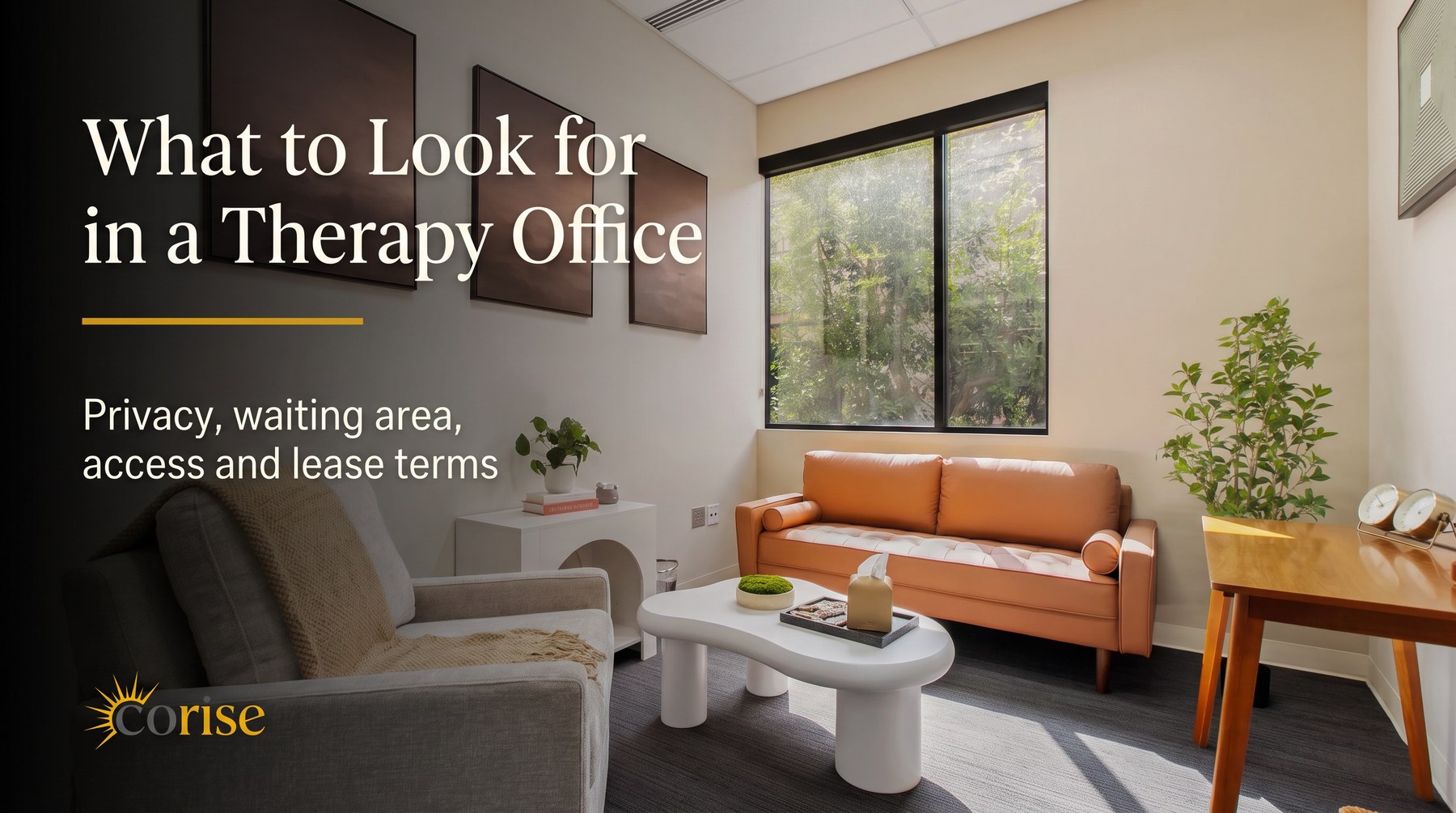
What to Look for in a Therapy Office
Privacy, waiting area, access and lease terms, checked against the HIPAA Privacy Rule and the ADA rather than against what landlords put in their brochures. Written by the people who rent out the rooms, which is why the first section argues against a phrase our own industry leans on.
CoRise rents furnished therapy rooms, telehealth pods and conference space in Ontario, California. We rent workspace, so we have a commercial interest in you renting an office, and the questions in section 7 are ones you should be asking us as well as anyone else. CoRise memberships are month to month and are not commercial leases, so section 5 describes the agreement you are likely to meet elsewhere rather than ours.
We are not a law firm and we do not provide clinical care. Nothing here is legal advice. The regulations cited below are federal and are linked to their originals so you can read them without us in between.
The short answer
Four things decide whether a room works: whether a conversation carries through the door, whether a client can arrive and leave without being seen by the wrong person, whether someone using a wheelchair can actually get in, and what the agreement lets you walk away from. Everything else is furniture. Sit in the room with the door closed before you sign anything.
Key facts, verified
- There is no such thing as a HIPAA-certified office. HHS does not endorse or recognize private certifications, and holding one does not absolve you of your obligations.
- The Privacy Rule does not require you to eliminate all risk of being overheard. It requires reasonable safeguards to limit incidental disclosure. 45 CFR 164.530(c)(2).
- Sign-in sheets are permitted. So is calling a client's name in a waiting room. HHS has said so explicitly since 2002.
- The sheet may not show why the person is there. That is the line, not the sheet itself.
- A therapy office is a place of public accommodation under the ADA, because the statute names the professional office of a health care provider. 42 U.S.C. 12181(7)(F).
- A lease clause cannot move your ADA liability. Landlord and tenant are both liable, and allocation in a lease is only effective between the two of them. 28 CFR 36.201(b).
- We could find no federal rule specifying a sound rating for a therapy room, and none in California either. Any number a landlord quotes you is a construction spec, not a compliance threshold. Section 6 covers what we checked.
Verified against HHS Office for Civil Rights FAQs 199, 206 and 2003, 45 CFR 164.530, 42 U.S.C. 12181, and 28 CFR 36.201. All checked 31 August 2026. Federal regulations change through rulemaking and agency guidance is periodically revised, so confirm currency before relying on any of it.
Contents
- The phrase to stop shopping for
- Privacy: what the rule actually asks of a room
- The waiting area, and the sign-in sheet myth
- Access: the question almost nobody asks
- Lease terms: what a clause can and cannot move
- The one thing we could not verify
- The walkthrough, in order
- Questions therapists actually ask
1The phrase to stop shopping for
If you search for therapy office space you will find listings advertising HIPAA-compliant rooms. It is a comfortable phrase and it means nothing, which matters because it is doing the work of a guarantee in a decision where you carry the liability.
HIPAA-compliant offices. HIPAA-certified suites. Fully compliant clinical space. The implication is that the room has been assessed against a standard and passed, and that renting it transfers some part of the obligation to the landlord.
There is no certification to hold. HHS states that no standard requires a covered entity to certify compliance, that it does not endorse or otherwise recognize private organizations' certifications regarding the Security Rule, and that such certifications do not absolve a covered entity of its legal obligations. OCR has said the same about the Privacy Rule and states that it does not certify any persons or products as HIPAA compliant. It adds that a certification by an outside organization does not prevent HHS from later finding a violation.
Compliance attaches to you, the covered entity, not to the room. A landlord can give you a door that closes, a waiting area that works and a lock on a filing cabinet. A landlord cannot make you compliant and cannot be certified as having done so. Any listing that implies otherwise is describing a product that does not exist.
Read a room's description with that in mind and the useful sentences separate from the decorative ones fairly quickly. Our own membership FAQ says the environment supports HIPAA-conscious practice and that providers are responsible for their own clinical compliance. That is the accurate way to say it, and it is the shape of sentence you want from anyone renting you a room.
2Privacy: what the rule actually asks of a room
Reasonable safeguards, scaled to your circumstances. HHS states plainly that the Privacy Rule does not require all risk of incidental disclosure to be eliminated, and that it does not specify the measures that must be applied.
That is a lower bar than most therapists assume and a more demanding one to evaluate, because there is no number to check against. What the standard does is put the judgement on you, which means the walkthrough matters more than the brochure.
The test worth running is the one you can do in ten minutes and nobody offers you. Ask to sit in the room, alone, with the door closed, during business hours on a day the building is busy. Have someone stand outside and hold a normal conversation at speaking volume. Then swap. You are not listening for whether you can hear a voice. You are listening for whether you can make out words.
Four things account for most failures: the gap under the door, shared ventilation running between two rooms, a hollow-core door on a solid wall, and a wall that stops at the drop ceiling instead of continuing to the deck above. The last one is invisible and it is the one that ruins otherwise good rooms, so it is worth asking directly whether the demising walls run full height.
What a white noise machine does and does not do
It raises the noise floor outside the door so speech stops being intelligible. It works and it is cheap. It does not repair a wall that stops at the ceiling, and it does not help if it is inside the room rather than outside it. Placed correctly it goes in the corridor or the waiting area, not next to your chair.
Where speech privacy actually fails
The four failure points named in this section, drawn in section through a typical suite. Three are visible on a walkthrough. One is not.
3The waiting area, and the sign-in sheet myth
That sign-in sheets violate HIPAA, and that calling a client's name in a waiting room is a disclosure you should avoid. Practice-management blogs repeat both, usually without a source, and therapists build awkward check-in workarounds around them.
Both are permitted. HHS states that covered entities may use patient sign-in sheets or call out patient names in waiting rooms, so long as the information disclosed is appropriately limited, and that the Privacy Rule explicitly permits the incidental disclosures that result, provided the entity has implemented reasonable safeguards and the minimum necessary standard where appropriate. Other people in the waiting area hearing the name called, or seeing names on the sheet, is contemplated by the Rule rather than prohibited by it.
The limit is what else is on display. HHS gives the example directly: the sign-in sheet may not show the medical problem the person is there about. A name and an arrival time is fine. A name next to a reason for the visit is not.
The line HHS actually draws
Both sheets show client names in a shared waiting area. One is permitted. The other is not, and the difference is a single column.
So the waiting area question is not really about sheets. It is about sightlines and timing. Two things are worth checking on a tour:
- Can a client leaving your room avoid walking past the next client? A single corridor with one door at the end forces every arrival and departure through the same three feet. Suites with a second exit, or enough corridor length to stagger, solve it without anyone noticing there was a problem.
- Who else uses the waiting area, and for what? A shared waiting room in a building with a dentist and an accountant is different from one shared with two other therapists. Neither is disqualifying. The second one means your client may see someone they know from group.
If you run back-to-back sessions, ask whether the schedule can be offset from the therapist next door by ten minutes. It is a scheduling question rather than a building question, and it removes the problem entirely. On our side, recurring weekly and biweekly bookings are supported, so the slot itself is not the problem, and an offset is a front desk conversation. Details are on the memberships page. It is the sort of thing worth raising before you commit rather than discovering in month two.
4Access: the question almost nobody asks
A therapy office is a place of public accommodation under the ADA. The statute names the professional office of a health care provider directly, at 42 U.S.C. 12181(7)(F). That is not a grey area and it does not depend on how many clients you see.
In practice this is the section of a tour that gets skipped, because the building looks fine to someone walking through it on two working legs. The things that decide whether a client can actually get to you are mostly not visible from the lobby.
- Route from the accessible parking space to your door. Not from the front entrance. From the parking space. Walk it.
- Door hardware and opening force. Lever handles rather than round knobs, and doors that open without shouldering them.
- The restroom, and how far it is. Whether it is on your floor changes a fifty-minute session more than anything else on this list.
- Elevators, and what happens when one is out. Ask what the building does. Ask how long the last outage lasted.
- Whether any of it changes after hours. A ramp entrance that gets locked at 6pm is not an accessible entrance for a 7pm client.
Walk it from the parking space, not the lobby
Five points on the route where access usually breaks, and the question to ask at each. None of them are visible from the front entrance.
That last one is worth pressing on generally. Evening availability is what most therapists actually need, because most clients come after work, and buildings quietly become different places at night. Our own space is available to members until 10pm, and the practical question to ask any landlord is not whether after-hours access exists but which specific doors, elevators and restrooms are still open when it does.
5Lease terms: what a clause can and cannot move
That a lease clause making the landlord responsible for ADA compliance protects the tenant. It reads that way, it is often offered as reassurance during a tour, and it appears in plenty of commercial leases.
Both the landlord who owns the building and the tenant who operates the place of public accommodation are public accommodations subject to Title III. The parties may allocate responsibility between themselves by lease or contract, but the Department of Justice states that any such allocation is only effective as between the parties, and both landlord and tenant remain fully liable for compliance.
The practical translation: a client who cannot get into your office can bring a claim against you regardless of what your lease says. The clause determines who ultimately pays between you and your landlord. It does not determine who can be sued. If a landlord offers that clause as a reason not to check the building, they have misunderstood their own document.
Terms that surface too late
What "month to month" means in this specific agreement.
It is a phrase, not a definition. Get the notice period in days, in writing, and ask what happens if you give notice mid-month.
Whether the rate is fixed for the term.
Ask what it was twelve months ago and what governs an increase. A landlord who cannot answer the first part is telling you something.
Everything outside the headline rate.
Deposits, key or fob fees, after-hours charges, cleaning, mandatory add-ons, and what a no-show or late cancellation costs you if the space is booked hourly.
Who else holds a key.
Cleaning crews, maintenance, building staff and other members may all have access. This is a reasonable thing for them to have. It is also a reasonable thing for you to know about before you decide where the file cabinet goes.
What happens when a room you booked is not available.
Double bookings, closures and maintenance happen everywhere. The question is what the remedy is, and it is much easier to ask now than during the ninety seconds before a session.
Whether you can hold the same slot every week.
Consistent appointment times are most of what makes a caseload work. Ask specifically whether recurring bookings are supported or whether you are competing for the room every week.
6The one thing we could not verify
What sound rating a therapy room needs. We could not find a requirement that specifies one, federal or Californian, and we are fairly confident none exists.
We went looking for a number on the assumption that one had to be out there. HHS FAQ 200 says the Privacy Rule does not specify the measures that must be applied to protect privacy while engaging in common health care practices. FAQ 206 says the Rule does not require all risk of incidental disclosure to be eliminated, only reasonable safeguards. Neither names a construction standard, and 45 CFR 164.530(c) sets a flexible, scalable safeguards obligation rather than a specification.
So when a landlord quotes you an STC rating, that is a construction specification for an assembly, and a useful one. It is not a compliance threshold, because there is no threshold to meet. It also describes the wall as built and tested in a laboratory, which tells you very little about the gap under your particular door.
We then checked California, since that is where our readers practice. The Confidentiality of Medical Information Act, Civil Code 56 and following, is the state law that governs confidential patient information here. It is a disclosure statute: it sets out who may release medical information and under what circumstances. It says nothing about how a room is built, and we found no California facility or construction standard applying to an outpatient therapy office either.
What we remain uncertain about is narrower. We did not review every county building ordinance, and we did not survey other states. If you have found a California requirement we missed, send it to us through the contact page and we will correct this section and say what changed.
It is also why our own pages say sound-conscious rather than soundproof. Soundproof describes a result we cannot promise for every conversation in every room, and we would rather you test the room than take the word.
In the meantime the honest position is the one in section 2. There is no number to ask for, so run the door test yourself and trust what you hear.
7The walkthrough, in order
Grouped by when you can actually do it. Three of these you can settle by email before you spend a morning on a trip that was never going to work. Five need you standing in the building. Four only matter once someone puts an agreement in front of you.
The middle column is the wording. It is there because the awkward part is not knowing what to ask, it is asking it out loud to someone who is trying to rent you something.
Before you visit
| What to check | Ask it like this | You are looking for |
|---|---|---|
| Wall construction | Do the demising walls run to the deck, or stop at the drop ceiling? | A yes or a no. If they do not know, an offer to find out. |
| Total monthly cost | Can you send every line item, not the headline rate? | A written breakdown including deposits, access fees and what happens at renewal. |
| Notice to cancel | How many days notice, and is that in the agreement? | A number, and the clause it comes from. |
On the walkthrough
| What to check | Ask it like this | You are looking for |
|---|---|---|
| Speech privacy | Can I sit in here with the door shut while someone talks outside, then swap? | Yes, now, without rescheduling. You are listening for words, not voices. |
| Arrival and exit paths | Can we walk the route a departing client takes past an arriving one? | Either two doors, or enough corridor to stagger by three minutes. |
| Waiting area sharing | Who else uses this waiting area, and during which hours? | Specific tenants and specific hours. A dentist is different from two other therapists. |
| Accessible route | Can we walk it from the accessible parking space rather than the lobby? | The whole route, including door force, and where the nearest restroom is. |
| After-hours reality | Which doors, elevators and restrooms stay open, and until when? | Named doors and times, not a general yes. |
Before you sign
| What to check | Ask it like this | You are looking for |
|---|---|---|
| Room availability | What happens if a room I have booked is not available? | A stated remedy, before you need it. |
| Recurring slots | Can I hold the same time every week, or do I rebook each time? | Whether recurring bookings exist, or whether you compete for the room weekly. |
| Elevator outages | What does the building do during an outage, and how long was the last one? | A real answer about the last one, not a policy. |
| What the lease moves | Which obligations does this agreement allocate, and to whom? | Clarity that allocation binds the two of you and not a third party. |
One thing that is not on any of the three lists: how the room looks. It matters to you and it barely registers with clients after the second session. Do not trade a wall that stops at the ceiling for better furniture.
If you want to run this checklist on us
You can book a tour and sit in a room with the door closed during business hours, which is the only part of this that cannot be answered over the phone. If you would rather try a full day before deciding anything, a day pass does that without a membership. It is $65, and it needs photo ID, a signed agreement and approval before your date. Rates and terms are on the memberships page, and you can see the rooms, telehealth pods and conference space on the space.
If the honest answer for you this year is a sublet or telehealth from home, that is a real answer and we would rather you reach it before signing something. Questions either way: get in touch.
CoRise, 4684 Ontario Mills Pkwy, Suite 200, Ontario, CA 91764. (909) 321-6565.
8Questions therapists actually ask
- Does a therapy office have to be HIPAA compliant?
- The office cannot be. Compliance attaches to you as the covered entity, not to the room. HHS states that it does not endorse or recognize private HIPAA certifications and that holding one does not absolve a covered entity of its legal obligations. What a room can do is make your own safeguards easier to implement. Any listing advertising a HIPAA-certified suite is describing something that does not exist.
- Are sign-in sheets a HIPAA violation?
- No. HHS states that covered entities may use patient sign-in sheets or call out patient names in waiting rooms, so long as the information disclosed is appropriately limited, provided the entity has implemented reasonable safeguards and the minimum necessary standard where appropriate. The Privacy Rule explicitly permits the incidental disclosures that result. The limit is that the sheet may not display the medical problem the person is there about. A name and an arrival time is fine.
- Can I call a client's name in the waiting room?
- Yes. HHS addresses this directly and treats it as a permitted incidental disclosure. Other people in the waiting area hearing the name is contemplated by the Rule. What you should not do is announce anything alongside the name, such as why the person is there or which service they are booked for.
- How soundproof does a therapy room need to be?
- We could find no federal or California rule that specifies a rating. The Privacy Rule requires reasonable safeguards to limit incidental disclosure and states that not all risk needs to be eliminated. So an STC number from a landlord is a construction specification rather than a compliance threshold. Test it yourself instead: sit inside with the door closed while someone speaks outside at normal volume, and listen for whether you can make out words.
- Is a therapy office covered by the ADA?
- Yes. The ADA lists the professional office of a health care provider as a place of public accommodation at 42 U.S.C. 12181(7)(F). This applies regardless of practice size. The practical checks are the route from accessible parking to your door, door hardware and opening force, restroom location, and whether any of it changes after hours.
- My lease says the landlord handles ADA compliance. Am I covered?
- Not in the way the clause suggests. Under 28 CFR 36.201(b) both landlord and tenant are public accommodations, and the Department of Justice states that allocating responsibility by lease is only effective as between the parties. Both remain fully liable. A client who cannot access your office can bring a claim against you whatever your lease says. The clause decides who ultimately pays, not who can be sued.
- What should I ask before renting a therapy office?
- Total monthly cost with every line item, the notice period in days, who else holds keys, what happens if a booked room is unavailable, whether you can hold a recurring weekly slot, and which doors and restrooms stay open after hours. Then sit in the room with the door closed during business hours before you decide anything.
- Do I need an office at all in my first year?
- Often not. If you have a room at home that nobody else walks into and a clinical population suited to it, telehealth is the lowest-cost path by a wide margin. A sublet from an individual therapist is usually the cheapest option after that. Renting hourly makes sense when you need a room some of the time; a lease wins once you need the same room every day.
Related reading
- Memberships and how booking worksCredits, hourly rates, recurring bookings and after-hours access
- The provider directoryClinicians already working out of the Ontario space
- The space itselfTherapy rooms, telehealth pods, lounge and conference rooms
Sources
- U.S. Department of Health and Human Services, Office for Civil Rights. FAQ 2003: Are we required to "certify" our organization's compliance with the standards of the Security Rule? Content last reviewed 26 July 2013. hhs.gov. Checked 31 August 2026. Supports the absence of HIPAA certification and that private certifications do not absolve legal obligations.
- U.S. Department of Health and Human Services, Office for Civil Rights. What You Should Know About OCR HIPAA Privacy Rule Guidance Materials: Be aware of misleading marketing claims. hhs.gov. Checked 2 September 2026. Supports that OCR does not certify any persons or products as HIPAA compliant under the Privacy Rule.
- U.S. Department of Health and Human Services, Office for Civil Rights. FAQ 199: May physician's offices use patient sign-in sheets or call out the names of their patients in their waiting rooms? Created 19 December 2002, content last reviewed 28 December 2022. hhs.gov. Checked 31 August 2026. Supports the sign-in sheet and name-calling permissions and the limit on displaying the reason for the visit.
- U.S. Department of Health and Human Services, Office for Civil Rights. FAQ 206: Is a covered entity required to prevent any incidental use or disclosure of protected health information? Content last reviewed 9 January 2023. hhs.gov. Checked 31 August 2026. Supports the reasonable safeguards standard and that not all risk must be eliminated.
- U.S. Department of Health and Human Services, Office for Civil Rights. FAQ 200: What safeguards are needed to continue common health care practices? hhs.gov. Checked 2 September 2026. Supports the statement that the Rule does not specify the measures that must be applied.
- 45 CFR 164.530(c). Administrative, technical and physical safeguards, and reasonable safeguards to limit incidental uses and disclosures. Checked 31 August 2026.
- 45 CFR 164.502(a)(1)(iii). Permitted incidental uses and disclosures. Cited within HHS FAQ 199. Checked 31 August 2026.
- 42 U.S.C. 12181(7)(F). Definition of public accommodation, including the professional office of a health care provider. Checked 31 August 2026.
- 28 CFR 36.201(b) and U.S. Department of Justice, ADA Title III Technical Assistance Manual, section III-1.2000. ada.gov. Checked 31 August 2026. Supports joint landlord and tenant liability and the limited effect of lease allocation.
Federal regulations are amended through rulemaking and agency guidance is periodically revised. Every source above carries the date we checked it. Confirm anything you are about to act on against the source before acting on it.
This article is general information about published federal regulations and agency guidance. It is not legal advice and it is not a substitute for consulting a licensed attorney about your circumstances. Where it describes a regulation, it reports what the cited text says and does not interpret how that regulation applies to any particular person, practice or building.
CoRise provides workspace. We do not provide clinical, legal or accounting services, we do not supervise, and members are responsible for their own professional and regulatory compliance. Nothing here guarantees any outcome for your practice.